AI Conversational Partners Relieve Loneliness Quickly. But Intimacy Doesn't Work That Way
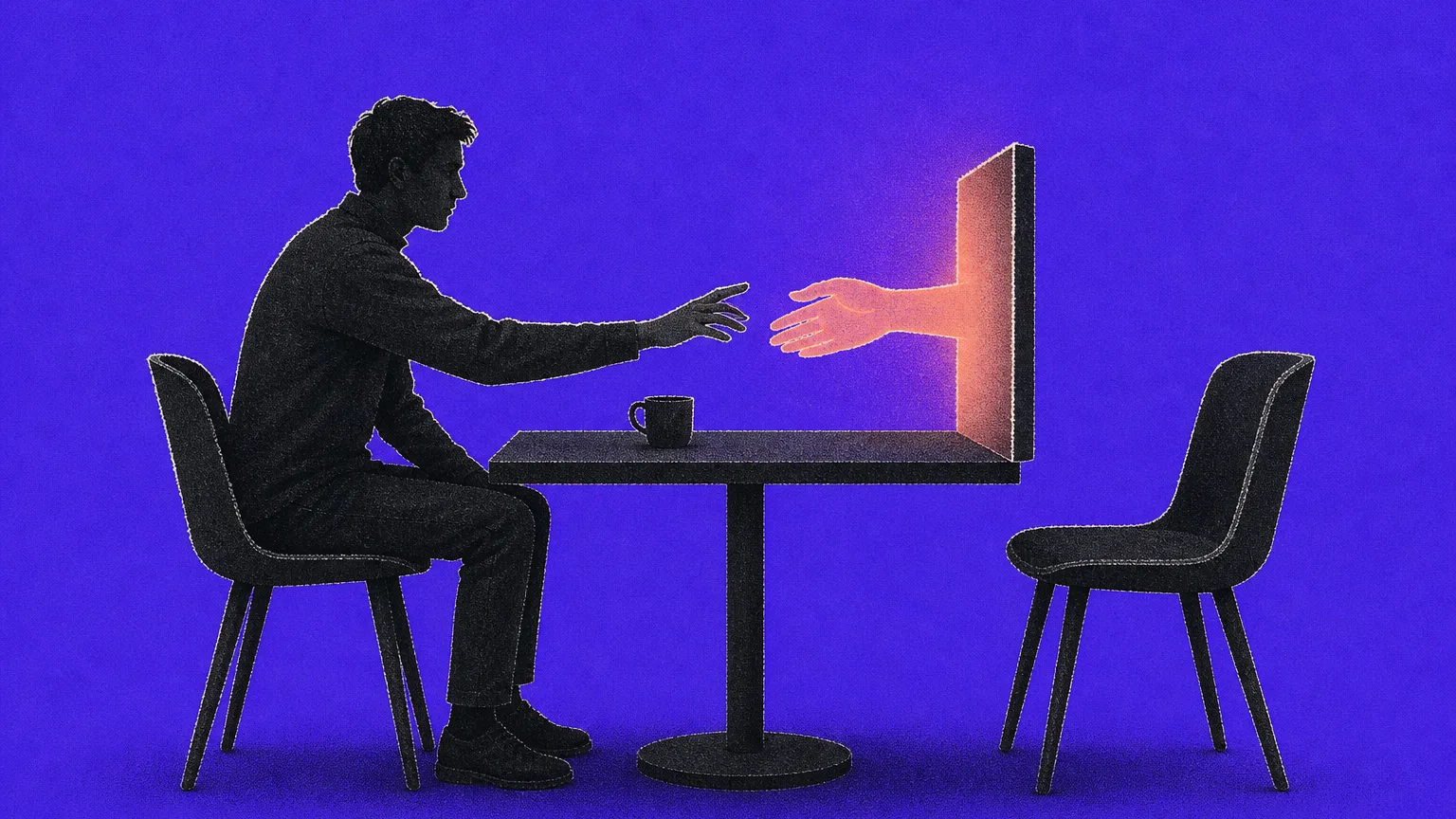
Loneliness has an unpleasant quirk: the longer you remain in it, the harder it is to emerge.
You have to be the one to message someone first. To schedule a meeting. To explain what is happening to you. To endure the awkwardness. To risk a cold reaction. To spend energy you already have in short supply.
Against this backdrop, an AI conversational partner seems like an almost perfect solution. It is always available. It doesn't get tired. It doesn't get annoyed. It doesn't interrupt. It doesn't judge. It doesn't require you to explain the context from scratch. You can talk to it at night, between meetings, after a failure, in a moment of anxiety, or simply when there is no one else around.
And initial data shows: yes, it works. But not as simply as one might hope.
What the new study showed
In 2026, a paper by Danigan Folk and Elizabeth Dunn regarding the connection between using chatbots for communication and loneliness was published in Psychological Science. This was not a short, one-evening experiment, but a longitudinal study: over 2,000 adults from the US, UK, Canada, and Australia were observed over 12 months, with four waves of surveys conducted every 4 months (Folk & Dunn, 2026).
The authors looked at two directions of the relationship.
First: does loneliness lead to a person using chatbots for social purposes more frequently?
Second: does using chatbots for communication lead to increased loneliness later on?
The result was both significant and cautious.
People who felt more emotionally isolated were more likely to start using chatbots for social purposes 4 months later. This is expected: if a person lacks contact, they look for an accessible form of contact.
But there was also a reverse correlation: an increase in the use of chatbots for communication predicted an increase in emotional isolation 4 months later. In other words, AI may provide short-term relief, but over time, it may fail to bridge the gap and instead amplify the feeling of loneliness.
The authors emphasize separately that the study is exploratory and not pre-registered; therefore, a firm causal conclusion cannot be drawn. However, the trend is troubling: lonely people turn to chatbots, and more active use of chatbots may be associated with further growth in emotional isolation.
Why it feels easier at first
The short-term effect is clear.
AI excels at imitating what a person lacks in a moment of loneliness: attention, acceptance, responsiveness, and continuous contact. It responds immediately. It adjusts to your tone. It does not require reciprocity. It does not leave. It doesn't say: "Listen, I don't have the capacity for this right now."
Other studies have already shown that talking with an AI companion can temporarily reduce loneliness. For example, the study AI Companions Reduce Loneliness shows that interaction with a friendly chatbot can provide an immediate reduction in loneliness, sometimes comparable to a short human contact (De Freitas et al., 2024/2025).
But the word "immediate" is important here.
AI can function well as an emotional pain-relief patch. It dulls the intensity of the state. It provides the sensation that you are being heard. It helps you articulate a thought. Sometimes that is enough to survive the evening, avoid a breakdown, or prevent sliding into an anxiety spiral.
The problem begins when the patch is mistaken for the cure.
Why the effect breaks down over time
Human intimacy is built not just on being listened to. It is built on reciprocity.
In relationship psychology, the role of self-disclosure has long been studied: people grow closer when they gradually reveal personal thoughts, fears, weaknesses, and desires to one another. In a classic experiment by Arthur Aron and colleagues, participants went through a series of increasingly personal questions over 45 minutes; this structure created a greater sense of intimacy than ordinary small talk (Aron et al., 1997).
The key word here is "to one another."
Intimacy arises not only because I tell you about myself, but because the other person is taking a risk, too. They are spending attention, time, emotions, and their own limited life. They might get tired. They might disagree. They might get offended. They might choose to stay. They might reveal themselves in return.
It is this limitation that makes human contact valuable.
AI, however, risks nothing. It has no personal vulnerability. It has no life of its own that it sets aside for a while just for you. It has no internal cost for participation. It can generate an infinite number of warm phrases, but it is precisely this infinity that reduces their weight.
If a human says, "I am with you," they could have chosen to be elsewhere. If a chatbot says, "I am with you," it is simply continuing the session.
The illusion of reciprocity
Researchers Folk and Dunn discuss this mechanism directly: AI can mimic care, understanding, and self-disclosure, but it has no real "self" to reveal. Moreover, they cite data suggesting that a chatbot’s artificial self-disclosure may even decrease the feeling of connection, because the person senses a simulation rather than authenticity (Folk & Dunn, 2026).
This explains a strange paradox.
At first, AI seems like an ideal conversational partner precisely because it requires no reciprocity. It is safe. You can talk only about yourself. You don't have to worry about whether you are overloading the other person. You don't have to confront their separate existence.
But long-term intimacy requires the other person's separateness.
A real conversational partner is inconvenient. They have boundaries, moods, interests, and their own point of view. They might not say what you want to hear. But that is exactly why their presence is real.
AI is convenient because it removes almost all friction. Yet part of that friction is what creates the sensation of genuine contact.
Why this is especially important for entrepreneurs
For entrepreneurs, loneliness often looks not like an absence of people, but like an absence of peer-level conversations.
You may be surrounded by a team, clients, contractors, investors, and family. But some decisions must be kept internal: money is running out, sales have dipped, a partner isn't performing, the team is anxious, the strategy isn't working—yet you must maintain a calm exterior.
A founder is often not physically alone. They are alone in their responsibility.
And here, AI truly becomes a seductive tool. You can tell it everything: fears, doubts, anger, uncertainty, unpleasant hypotheses. It won't quit, it won't get scared, it won't lose trust, it won't tell the team.
For initial processing of thoughts, this is useful. AI can help structure anxiety, formulate options, spot contradictions, and prepare for a conversation. In this sense, it is like a very accessible scratchpad for your thinking.
But it does not replace a conversation with a human who carries their own experience and bears their own risks.
A mentor, partner, or fellow entrepreneur might say: "I was in the same spot, and here is where you are fooling yourself." They might disagree. They might ask a question that makes you uncomfortable. They might spend an hour of their limited time on you. And that is exactly what makes the conversation not just a generation of support, but a real social exchange.
In the context of United Mentors, this is an important boundary: AI can help prepare your thoughts for a conversation, but the conversation itself with an experienced entrepreneur is valuable precisely because on the other side there is not a model, but a person with a biography, mistakes, stakes, and limited time.
What does not follow from these data
The research does not imply that AI conversational partners are always harmful.
That would be too coarse an interpretation. In the short term, they can reduce loneliness, help articulate thoughts, and provide emotional support when no other contact is available. For some people, this may be a bridge rather than a replacement.
The problem is not the mere fact of talking to an AI.
The problem is substitution.
If AI helps you prepare for a live conversation—that is one thing. If AI becomes a way to avoid going into a live conversation—that is another.
If it lowers the intensity of your state so you can take action—that is useful. If it turns into an endless safe room where you don't have to risk relationships—that is risky.
The main criterion is simple: after interacting with AI, do you have more real human contacts, or fewer?
Practical conclusion
AI conversational partners should be used as a tool, not as a social environment.
You can ask it to help formulate what is bothering you. Prepare for a difficult conversation. Analyze solution options. Find the words to message someone. Lower emotional noise before a meeting with a mentor, partner, or friend.
But do not outsource the entire function of intimacy to it.
Because intimacy is not just understanding. It is reciprocity, limitations, vulnerability, and the time of another person. Things that cannot be generated on demand.
Folk and Dunn’s research is important precisely for this reason: it does not say "chatbots are bad." It shows something more nuanced. Lonely people naturally go where it is easier to get a response. But if that response remains one-sided and displaces live connections, loneliness may return even stronger.
For an entrepreneur, this is especially relevant. You can discuss ideas with AI. You can prepare decisions with AI. You can even temporarily offload anxiety through AI.
But the most important conversations should still be held with people.
Because business is built not only on intellect. It is built on trust, honest feedback, and the lived experience of another human being.