Learned Helplessness: Why Entrepreneurs in Crisis Stop Acting Even When the Exit is Open
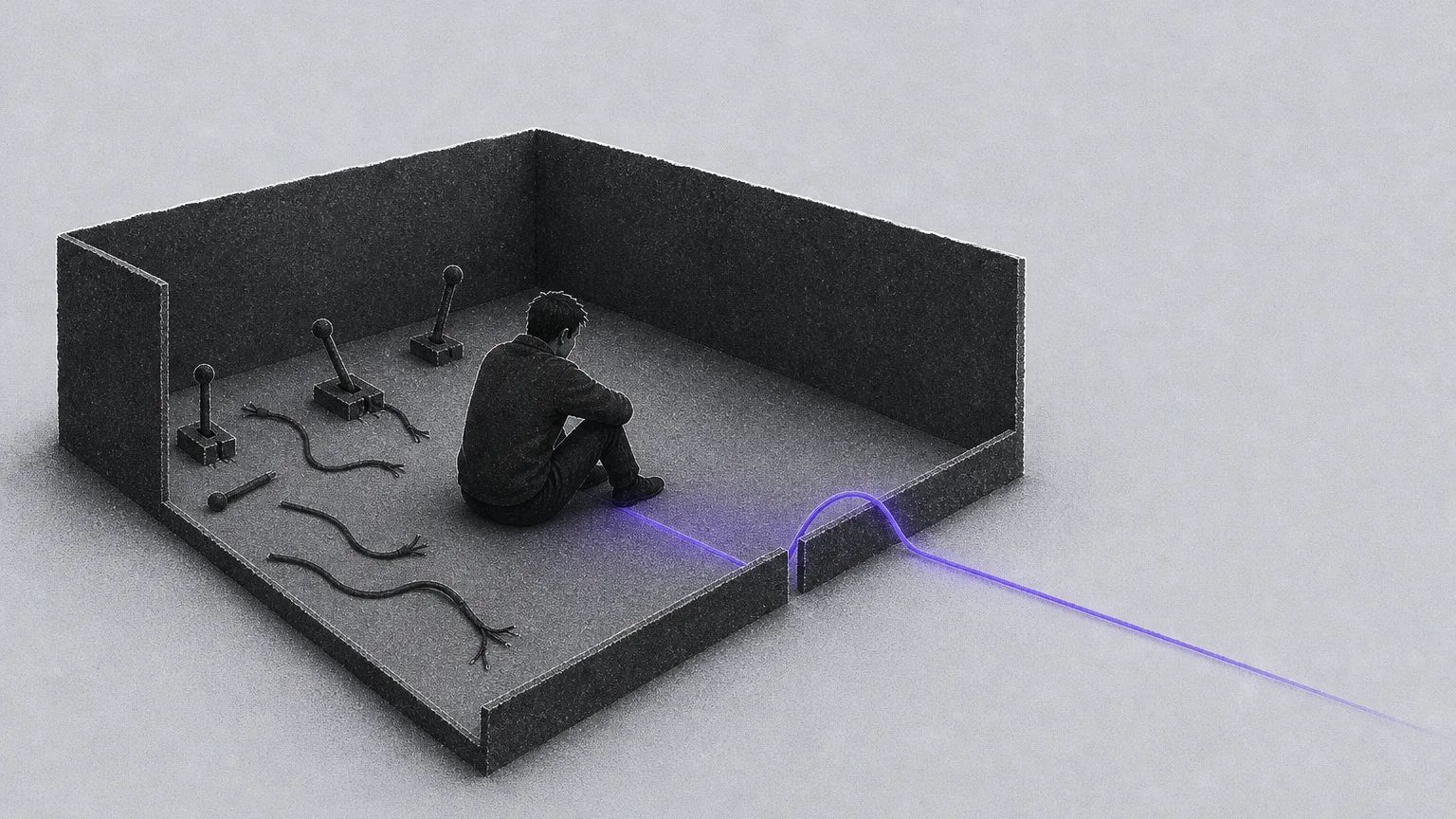
There is a state that entrepreneurs in crisis describe in similar terms: "I understood everything, I saw what needed to be done, but I couldn't bring myself to do it." Money was running out, the team was falling apart, clients were leaving—and the person continued to act out of inertia or did almost nothing. Not because they didn't know the way out, but because they had stopped believing that an exit existed.
This is not a character flaw or panic. It is a predictable psychological mechanism described by science as early as 1967. And understanding this mechanism is the first step toward overcoming it.
The Dogs That Didn't Jump
In 1967, Martin Seligman and Steven Maier, then graduate students at the University of Pennsylvania, conducted a classical conditioning experiment involving dogs. The experiment yielded an unexpected result that became one of the most cited discoveries in clinical psychology: the paper Failure to Escape Traumatic Shock was published in the Journal of Experimental Psychology (Seligman & Maier, 1967).
The design had three parts. The first group of dogs received electric shocks that could be stopped by pressing a panel with their noses. The second group received the same shocks, of the same intensity and duration, but the panel did not work; it was impossible to avoid the shock. The third group received no shocks at all.
The next day, all three groups were placed in a box with a low partition: if they jumped over it, the electric shock would stop. The first and third groups quickly learned to jump over. The second group, for the most part, did not. The dogs lay on the floor and endured the shocks without trying to cross the barrier, which was easily surmountable.
Seligman interpreted this as learned helplessness: the dogs had learned that their actions did not influence the outcome, and this learning generalized to a new situation—even where control was now possible.
This discovery was replicated in experiments with humans: instead of electric shocks, a loud, unpleasant sound was used; instead of a panel, a button. Participants previously exposed to uncontrollable noise performed worse on anagram tasks—even when the tasks were solvable. However, about a third of the participants did not become helpless under any conditions—a fact Seligman noted and later returned to in his book Helplessness: On Depression, Development, and Death.
Refinement After 50 Years: The Brain is Passive by Default
In 2016, Maier and Seligman published the article "Learned Helplessness at Fifty: Insights from Neuroscience" in Psychological Review, revising the original interpretation (Maier & Seligman, 2016). This is a fundamentally important refinement that changes the practical conclusions.
The initial theory argued that passivity is learned in response to uncontrollable events. Neurobiological data showed the opposite. Passivity is the brain's default state. It is mediated by the activity of the dorsal raphe nucleus, which suppresses avoidance attempts through serotonergic mechanisms. This is a basic reaction to prolonged aversive events—it does not require learning.
What requires learning is activity. Control over a situation is learned via the medial prefrontal cortex, which, upon detecting control, automatically suppresses the activity of the dorsal raphe nucleus and allows the organism to act.
In other words: when a crisis reaches a certain duration and intensity, the brain returns to its default setting—passivity. This is not a moral failure; it is neurobiology. The task is to give the brain enough experience of control so that an active reaction becomes available again.
Who Becomes Helpless: Explanatory Style as a Risk Factor
Not all dogs in the experiment became helpless. About a third continued to jump. The same third appeared in human experiments. This fact posed a question for Seligman: what distinguishes those who become helpless from those who do not?
In 1978, Lyn Abramson, Martin Seligman, and John Teasdale published a reformulated theory of learned helplessness in the Journal of Abnormal Psychology (Abramson, Seligman & Teasdale, 1978). The key addition was explanatory style as a moderator that determines who among people turns failure into helplessness and who does not.
Explanatory style is described by three dimensions.
Internal vs. External. When something goes wrong, does the person explain it through themselves ("I am a bad entrepreneur") or the situation ("this market turned out not to be ready for this product")?
Stable vs. Unstable. Is the cause permanent ("I always make the wrong decisions") or temporary ("this time I underestimated the risk")?
Global vs. Specific. Does the cause affect everything ("I have no aptitude for business") or only a specific situation ("this monetization model did not work in this segment")?
A pessimistic explanatory style—internal, stable, global—is a strong predictor that failure will turn into helplessness. An optimistic style—external, unstable, specific—is protective.
This does not mean you should absolve yourself of responsibility for mistakes. It means something more precise: the way you explain failure to yourself determines whether you will retain the ability to act next time.
Why the Entrepreneur is Especially Vulnerable
The entrepreneur's environment creates several conditions under which learned helplessness develops faster than in other contexts.
A Chain of Uncontrollable Events. A business crisis is rarely a single event. More often, it is a series: a key employee leaves, revenue drops, a conflict with a partner intensifies, then an important deal falls through. Even if each of these events is theoretically manageable, the subjective feeling of losing control grows—and the brain begins to generalize.
Isolation. Research in the field of entrepreneurial resilience shows that social support is a significant protective factor. The work of Ahmed, Ucbasaran, Kaciak, and Williams on stress, adaptation, and resilience in entrepreneurship explicitly emphasizes that social connections help entrepreneurs withstand crisis and not lose the ability to act (Ahmed et al., 2022). An entrepreneur who hides a crisis from their environment due to shame or pride deprives themselves of this protective buffer.
Attributing Failure to Oneself. Entrepreneurial identity is often tightly bound to the business. When the business is in crisis, the entrepreneur is highly likely to explain it internally, stably, and globally: "this means I am a failure as an entrepreneur." Research on entrepreneurial resilience shows that an internal locus of control and self-efficacy significantly influence the willingness to learn from failure and resume entrepreneurial activity (Frontiers in Psychology, 2021). However, an internal locus of control without a healthy explanatory style can work against the entrepreneur: a person who considers themselves the agent of their own life is more likely to explain failure through themselves in a moment of crisis—and risks arriving at a pessimistic interpretation.
Lack of Feedback Loop. In a stable environment, an entrepreneur receives regular signals that their actions are working: sales are growing, the team is reacting, the market is responding. In a crisis, these signals disappear or are inverted: efforts yield no results, the market does not respond, the team falls apart. The brain begins to register the pattern "action does not affect outcome"—the very pattern that produced helplessness in Seligman's experiments.
How to Emerge: The Recovery Mechanism
Maier and Seligman showed that helplessness is reversible. In the experiment with dogs, the researchers physically picked up the animals and moved their legs, reproducing the movement of a jump—again and again—until the dogs began doing it on their own. One or two such episodes were enough for the dog to regain the ability to act.
For humans, the equivalent mechanism is accumulating experience of control through manageable situations. This is not about self-affirmation therapy ("I can do it, I am strong"). It is about specific experience that action influences outcome. The brain needs to "see" the link between an act and a result again.
For an entrepreneur in crisis, this means a few concrete things.
Narrow the Zone of Action to the Manageable. If the market is not responding and money is running out, an attempt to "save the whole business" with one big decision rarely restores the feeling of control—the stakes are too high, and the result is too unpredictable. It is more productive to find a zone where you can act and immediately see a result: a specific client, a specific task, a specific small step. This is not about thinking small—it is about restoring the neural pattern "action → result."
Reformulate the Explanation of Failure. Abramson, Seligman, and Teasdale show that a pessimistic explanatory style is a risk factor, not a personality trait. It can be changed through conscious work with attribution. It makes sense to ask the question "why did this happen" with explicit attention to how specific, temporary, and external the explanation is. This is not self-deception—it is accuracy: "this monetization model did not work in this segment during this period" is more accurate than "I am a bad entrepreneur."
Restore Social Support. Data on entrepreneurial resilience points directly to social connections as a protective factor. Isolation reinforces helplessness, while a supportive environment weakens it. A mentor, a partner, or a community of entrepreneurs who have been through crises is not "psychological support" in the soft sense of the word. It is a structural protective mechanism that reduces the likelihood that the situation of lost control will generalize into a global feeling of helplessness.
This is precisely where United Mentors can be a practical tool for finding a way out of a dead end. On the platform, an entrepreneur can find not an abstract "coach," but a person who has already faced similar crises: falling sales, cash flow gaps, team collapse, the wrong segment, or a failed hypothesis. Such a conversation restores an external point of support: it helps to separate facts from interpretations, find a manageable zone, and turn "everything is useless" into a set of verifiable actions.
Distinguish Between Helplessness and Fatigue. Sometimes the feeling of being unable to act is not helplessness, but depletion of resources. These are different states with different mechanisms and different ways out. If, after a short recovery (sleep, physical activity, a break), the ability to act returns, it is more likely exhaustion. If it does not return and generalizes to areas unrelated to the crisis, it is closer to learned helplessness.
What Does Not Work
The advice "just do it" does not work. The mechanism of learned helplessness according to Maier and Seligman is biological: the brain defaults to a passive mode, and returning to an active mode is impossible through one act of willpower. It is the same as telling a person with a broken leg to "just walk." Willpower here is not a tool for recovery—it is a tool for a state that has already been recovered.
Waiting for it to "pass on its own" also does not work. Without restoring the "action → result" loop, helplessness does not go away. The brain needs new experience of control, not just time.
Attempting to solve the problem through rethinking in isolation does not work. A pessimistic explanatory style is reinforced in conditions of loneliness and weakened in conditions of an honest conversation with people who see the situation from the outside. An external view is not a consolation, but a tool for correcting attribution.
Summary
Learned helplessness is not a characteristic of a weak personality or a consequence of a wrong attitude toward life. It is a predictable neurobiological mechanism that is triggered by prolonged exposure to uncontrollable aversive events. An entrepreneurial crisis—especially a chain of failures without a feedback loop in conditions of isolation—creates exactly these conditions.
Knowing this mechanism is useful twice over. First, it removes the moral interpretation of the state: it is not cowardice or weakness, it is biology. Second, it points to what actually works: not motivation or will, but the restoration of the experience of control through small, manageable actions, the correction of explanatory style, and the restoration of social connections.
The dogs in Seligman's experiment regained the ability to act after two or three physically guided jumps. An entrepreneur needs roughly the same thing—only the jumps are called something else.