The Strength of Weak Ties: Where Opportunities Really Come From
Most entrepreneurs intuitively invest in their inner circle: people they have a lot in common with, stay in regular contact with, and trust. The logic is clear: strong ties help when you need support, when something goes wrong, or when you need advice from someone who knows you.
The problem is that the data shows the opposite. When it comes to new opportunities, such as jobs, clients, investments, and partnerships, they are more likely to come not from close friends but from casual acquaintances. From people you know only superficially, rarely see, and share few connections with.
This is called the strength of weak ties, and over the past fifty years, enough research has accumulated to understand why it works and what it means for entrepreneurs.
Granovetter’s Research: How People Find Out About Jobs
This line of research began with sociologist Mark Granovetter’s paper “The Strength of Weak Ties,” published in the American Journal of Sociology in 1973. It is one of the most cited papers in the social sciences, and its core ideas are worth examining.
Granovetter studied how 282 people in the United States found jobs. He found that most learned about job openings not through close friends or relatives, but through acquaintances—people they had weak, infrequent contact with. The person who told them about the job was more often a former colleague they had not seen in a long time or someone they had met at a shared event than a family member or best friend.
Granovetter distinguished between strong ties (close friends and family—regular contact, many mutual connections, and high trust) and weak ties (casual acquaintances—rare contact, few mutual connections, and formal or superficial interaction).
The key takeaway: weak ties give you access to different information. Your close friends move in the same circles as you, know roughly the same people, and receive the same information. Weak ties move in different circles—they have different sources, a different network, and different information. That makes them more likely to tell you about something you do not know yet.
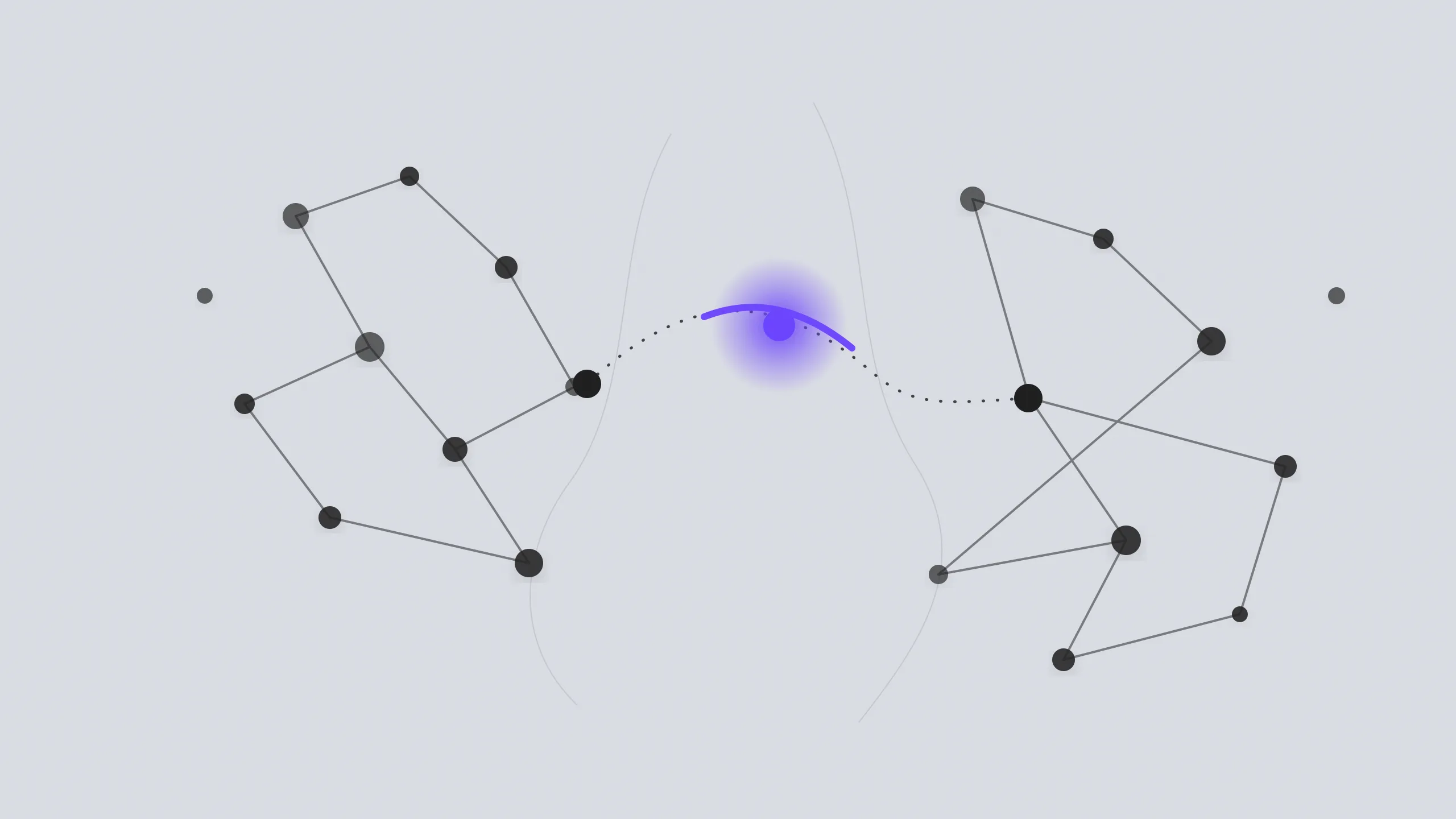
Granovetter calls weak ties bridges between clusters. Strong ties are grouped within clusters (your family, close friends, and regular colleagues). Weak ties extend a bridge from your cluster to another one. And it is across these bridges that new information travels.
Experimental confirmation: the 2022 LinkedIn study
Granovetter’s work was influential, but it was not experimental. In other words, it showed a correlation but could not definitively prove causation — it was possible that people who find jobs through weak ties simply differ in other ways.
A large-scale study published in the journal Science in 2022 addressed this problem. The authors — Kartik Rajkumar, Guillaume Saint-Jacques, Iavor Bojinov, Erik Brynjolfsson, and Sinan Aral — conducted a series of experiments on the LinkedIn platform involving more than 20 million people over five years. During that time, approximately 2 billion new connections were created and 600,000 job changes were recorded.
The experiment worked as follows. LinkedIn recommends people through its “People You May Know” algorithm. The researchers randomly varied the types of connections the algorithm recommended to different groups of users — more strong ties or more weak ties. They then tracked how this affected job changes.
Result: weak ties do in fact increase mobility in the labor market. Users who were shown more weak-tie recommendations by the algorithm were more likely to change jobs over the following years. This was the first large-scale experimental confirmation of Granovetter’s hypothesis.
But the study added an important qualification. The effect was nonlinear. It was not “the weaker, the better,” but an inverted U-shaped curve. Moderately weak ties produced the greatest effect: people with whom you share about 10 mutual contacts and interact infrequently. Extremely weak ties (people you barely know) worked less well. This matters because it shows the limits of the effect: the tie must be weak enough to connect you to a different circle, but real enough for the person to pass along meaningful information.
Why Weak Ties Work Better Than Strong Ones
The mechanism is clear and follows directly from the structure of networks.
Your close friends know roughly the same people you do. You have a high degree of network overlap. This means that information your close friend receives will likely reach you through other mutual acquaintances as well. Information redundancy.
A weak tie knows different people. They have their own circles, sources, and information environment. When they pass information on to you—about a job opening, a client, an investor, or a partnership—that information is likely to be new to you because you do not directly overlap with their sources.
This explains why weak ties are critically important in entrepreneurship, especially at the opportunity-search stage. Your close circle knows roughly the same market you do. Weak ties know different markets, different niches, and different people with money.
Weak Ties in the Entrepreneurial Context
For a founder, this has several practical implications.
First: where customers and investors come from. Research shows that startup founders’ first customers often come through weak ties rather than close friends. The same is true of investors. A referral from a casual acquaintance who is themselves connected to the right circle works better than repeatedly reaching out to a close friend who simply isn’t part of that environment.
This aligns with the topic of warm introductions that we discussed in the article about pitches. But it’s important to add one point: a warm introduction is effective precisely because it comes through a weak tie that serves as a bridge into another network. If you try to raise money only through close friends, you will most likely hit the ceiling of their network, which is structurally similar to yours.
Second: why being confined to a single community is a risk. If a founder moves only within one environment—only among other founders, only among technologists, or only within one industry—they have many strong ties within that environment but few bridges outward. This limits access to opportunities beyond it.
The counterintuitive conclusion is that entrepreneurs benefit from regularly spending time in different environments. Not to make lots of friends, but to build weak ties that lead into different circles. One conference where you did not form any deep friendships but exchanged contact information with ten different people is often more valuable than ten meetings with the same narrow circle.
Third: how to build weak ties intentionally. Strong ties are built through repeated contact and depth. Weak ties are built through a variety of contacts and maintaining minimal visibility. This does not require much time, but it does require consistency.
Specific tactics that work:
- Attend different events in adjacent, but not identical, fields. Not just niche conferences for your market, but also broader ones: technology, industry, and regional events.
- Maintain weak ties through infrequent but regular contact. This does not mean writing every week. It means not disappearing completely. One touchpoint every three to six months is enough to keep the relationship alive.
- Work in cross-functional communities. For example, if you are a technical founder, it is useful to have weak ties with marketers, product managers, and finance professionals. They know other people and other opportunities.
It is important to understand that weak ties are not about collecting connections for the sake of collecting them. They are about access to different flows of information. A thousand LinkedIn contacts you have never interacted with do not count. A weak tie is a real person who, when necessary, may remember you and pass along information.
What the Data Shows About Startup Founders
There is a separate body of research that has examined venture-backed startup founders. A study by Hiroshi Nozawa and Rihei Kanga, published in the Journal of the International Council for Small Business, surveyed 19 founders of startups that had raised venture funding and found that their decision to start a business was more often shaped by the influence of weak ties (acquaintances, senior colleagues, chance encounters) than by close relatives or friends.
This contrasts with traditional small businesses, where family and one’s close circle play a decisive role. For startups focused on rapid growth and venture funding, the network structure is different: weak ties provide access to a different type of information, a different type of person, and a different type of opportunity.
Another study, published in the Technology Innovation Management Review in 2023, found that business networks (professional contacts, weak ties) have a greater impact on attracting investment than personal networks (family, close friends), especially at later stages of a startup. At the early stage, personal networks compensate for the lack of business networks, but as the company grows, the balance shifts toward weak ties.
Limitations and what does NOT follow from this
None of the above means that strong ties are useless. That would be a misreading.
Strong ties provide what weak ties cannot: support in a crisis, deep trust, and help when everything is going wrong. When you need advice on a complex personal decision, moral support, or someone who knows you well enough to point out your blind spots, strong ties are indispensable.
The problem arises when an entrepreneur tries to find opportunities solely through strong ties. This is structurally inefficient because strong ties lead to the same circles you are already part of.
That does not mean you should turn all your connections into weak ties. That is the opposite extreme, and it does not work well either. LinkedIn data showed that extremely weak ties (near-strangers) work less effectively than moderately weak ties. The connection needs to be real enough that the person can and wants to pass information along to you.
Weak ties are not a substitute for strong ties. They are a complement that solves a different problem. Strong ties provide depth; weak ties provide breadth. Entrepreneurs need both.
What to Do About It
Several practical implications follow.
Build weak ties deliberately, rather than only deepening strong ones. If you attend the same meetings with the same people, you are deepening strong ties but not building bridges into new circles. Set aside some of your time to diversify your contacts—different communities, different industries, different formats. This is not social activity for its own sake; it is infrastructure for accessing opportunities.
Maintain weak ties with minimal contact. A weak tie dies if you disappear completely. One brief touchpoint every few months (not necessarily a meeting—it could be a message, comment, or contextual like) is enough to keep the connection alive. This does not take much time, but it does require a system—for example, setting a quarterly reminder to review the list of people you should stay in touch with.
Look for bridges, not clusters. When deciding which community or event to invest in, ask yourself: does it lead me into a circle I am already part of, or into a new one? Two events with the same audience give you the same network. Two events with different audiences give you bridges.
Do not ignore people who are bridges themselves. Some people are naturally connected to different circles—consultants, journalists, event organizers, and people who have worked across different industries. One weak tie with such a person provides access to many circles at once. This does not mean using them cynically—it means understanding the value of these connections and investing time in them.
Conclusion
The most useful takeaway from fifty years of research on weak ties is a shift in how you think about where opportunities come from. Intuition says close friends will help. The data says new opportunities more often come from people you know superficially, because they know different people, move in different circles, and have access to different information.
For an entrepreneur, this means that networking is not about making lots of friends. It is about intentionally building bridges between different circles. Strong ties provide support. Weak ties provide access. You need both, but they solve different problems.
If you invest only in deepening existing relationships, you limit your access to opportunities to the structure of your current network. Weak ties are a way to break out of that structure.
Sources:
-
Granovetter M.S. The Strength of Weak Ties // American Journal of Sociology, 1973, 78(6): 1360–1380. — https://snap.stanford.edu/class/cs224w-readings/granovetter73weakties.pdf
-
Rajkumar K., Saint-Jacques G., Bojinov I., Brynjolfsson E., Aral S. A Causal Test of the Strength of Weak Ties // Science, 2022, 377(6612): 1304–1310. — https://www.science.org/doi/10.1126/science.abl4476
-
Brynjolfsson E., Rajkumar K., Saint-Jacques G. et al. The Real Strength of Weak Ties (popular summary) // Stanford Report, September 15, 2022. — https://news.stanford.edu/stories/2022/09/real-strength-weak-ties
-
Nozawa H., Kang R. Changes in networks influencing startup founders’ entrepreneurial activity: the growing importance of weak ties // Journal of the International Council for Small Business, 2025, 6(3): 494–502. — https://www.tandfonline.com/doi/full/10.1080/26437015.2024.2411596
-
Granovetter M.S. The strength of weak ties: 50 years later (interview) // Stanford Report, July 24, 2023. — https://news.stanford.edu/stories/2023/07/strength-weak-ties